

Prime homes in Singapore’s Core Central Region (CCR) are quietly edging back into the spotlight. After several years where buyer demand leaned strongly towards the Rest of Central Region (RCR) and Outside Central Region (OCR), recent months have seen renewed activity in the CCR, driven by tighter price gaps, improved layouts in new launches, and a growing pool of buyers taking a longer-term view.
On this episode of Open House, hosts Susan Ng and Felicia Tan welcomed two guests to unpack what is really driving this shift in the prime market, before taking a closer look at The Robertson Opus — a rare 999-year redevelopment along Robertson Quay that reflects how CCR projects are being repositioned for the next phase of demand.
Table of contents
- Prime homes back in focus: Behind the CCR rebound
- Why new CCR launches are resonating more strongly
- Domestic buyers’ confidence in the CCR market
- Is this the start of a sustained CCR recovery?
- The Robertson Opus — Reimagining a familiar riverside landmark
- A unit mix designed for both lifestyle and longevity
- Elevated green living above a curated retail podium
- The Robertson Opus pricing and long-term positioning
Prime homes back in focus: Behind the CCR rebound
According to Dominic Lee, Head of Luxury Team and Investment Sales at PropNex Realty, the uptick in CCR activity did not happen by chance. “In 2025, we saw a larger number of homes being launched in the Core Central Region, so naturally, you’re going to see more transactions,” he explained. However, volume alone does not tell the full story.
A key shift lies in pricing dynamics across regions. Over the past two years, the price gap between CCR, RCR and OCR has narrowed to one of its tightest points in recent memory. “It’s at the narrowest point we’ve seen in the last couple of years,” Dominic said. “So buyers are starting to ask — if prices are so close, why not look at CCR?”
This recalibration has drawn a broader mix of buyers back into prime districts. While investors remain active, Dominic observed a noticeable rise in younger couples and newlyweds purchasing CCR homes as primary residences. “We’re seeing people buying these places to set up family homes,” he shared, noting that intent today is often mixed, not just as investments.
What feels different this time is buyer awareness. CCR purchasers today are not chasing short-term gains. Instead, they are leaning into fundamentals such as location quality, rentability, and long-term asset resilience. “People buying into CCR know it’s a quality asset,” Dominic said. “Location-wise, it’s better than anything else. Even if they don’t stay, they know rental demand is stronger than in RCR or OCR.”
Why new CCR launches are resonating more strongly
One factor reshaping buyer perception is unit harmonisation, which has quietly improved value propositions in newer launches. With non-usable spaces such as air-con ledges excluded from the saleable area, buyers are now paying for space they actually use.
“This is extremely important,” Dominic explained. “You’re no longer paying for about 7% of space that you can’t use.” As a result, newer 3-bedroom units can now be similar in size to older 2-bedroom + study layouts, making them more attractive for both own stay and rental.
Layout and design have also taken on heightened importance. Given the quantum involved in CCR purchases, buyers are scrutinising layouts closely. “Dumbbell layouts are extremely popular,” Dominic noted. “People look for such layout because they want to pay for the space they actually use.” At the same time, CCR developments often push design boundaries with higher-end materials and finishes that are less common outside the prime segment.
Domestic buyers’ confidence in the CCR market
Despite cooling measures, domestic confidence remains strong. Singaporeans continue to dominate CCR transactions, making up roughly 90% of buyers. Dominic also noted that some buyers are actively recycling capital — selling OCR or RCR properties and redeploying into CCR for better rentability and longer-term upside.
With 60% ABSD, foreign purchases have almost disappeared. “I can count on one hand the number of foreigners who have paid 60% ABSD.” Instead, international demand now comes primarily from ABSD-exempt nationalities such as Americans and Swiss buyers.
Rather listen to this podcast? Head over here:
Open House: A radio show/collabo between CNA 938 and 99.co
Is this the start of a sustained CCR recovery?
While some buyers worry about entering the CCR market late in the cycle, Dominic believes the recovery is still in its early stages. After lagging behind the RCR and OCR for several years, he noted that the recent pickup represents a long-awaited normalisation rather than a peak. “The CCR market has been lagging behind RCR and OCR for the last few years, so we’re only at the beginning,” he said, adding that it is “still quite safe” to enter the market at this point.
The key question, however, is whether this momentum can be sustained. From Dominic’s perspective, early indicators suggest improving confidence rather than speculative excess. “I think we’re just at the beginning of the market recovery for CCR,” he shared, pointing out that land bids in prime areas have started to come in stronger. A recent Government Land Sales closing for a Newton site crossed S$1,800 psf ppr, a record for that location, which could place pressure on surrounding property values.
That said, he was careful not to overstate the pace of the rebound. While fundamentals are strengthening, the recovery is unlikely to be linear. How sustainable it becomes will depend on how upcoming GLS sites perform and whether demand continues to build steadily. If so, Dominic expects a smoother, more measured upswing rather than a sharp or speculative surge.
The Robertson Opus — Reimagining a familiar riverside landmark
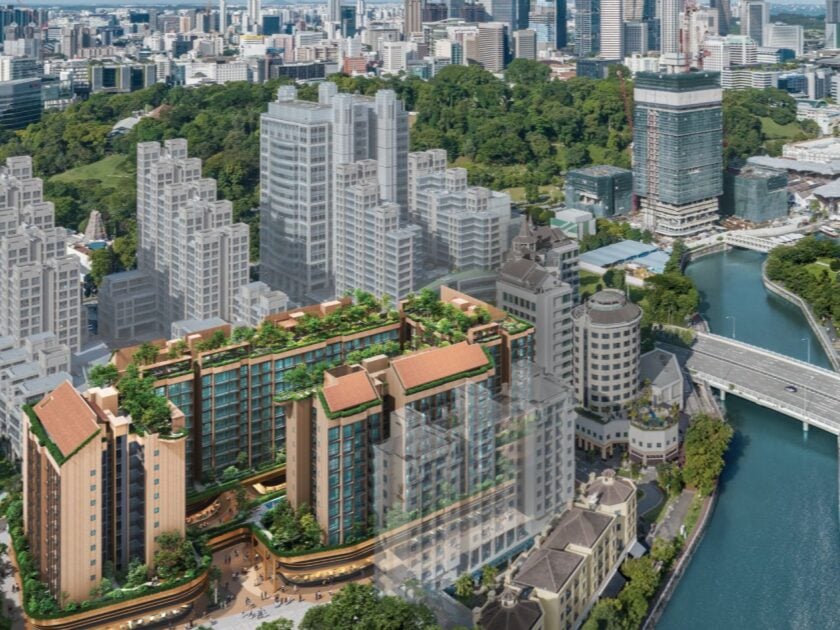
Against this backdrop of cautious optimism and improving fundamentals in the CCR, The Robertson Opus offers a timely case study of how CCR developments are being repositioned for the next phase of demand.
Located along Unity Street, Robertson Opus marks the transformation of the former Robertson Walk into a 999-year leasehold mixed-use luxury development comprising 348 residential units and 26 commercial units. Rather than reinventing the site, the redevelopment deliberately builds on the established character of Robertson Quay.
“What really stands out about Robertson Opus is that it doesn’t try to overwrite the character of Robertson Quay,” said Klyssa Chong, Senior Associate Director at PropNex Realty. “It actually builds on what was already there.”
Architecturally, the project breaks away from the single-tower format seen in many city-fringe launches. Instead, it comprises five mid-rise residential blocks, each nine to ten storeys high, sitting above a retail podium that retains the Robertson Walk identity. This approach preserves a more human-scale, walkable environment that aligns with how the precinct has historically functioned.
Warm-toned materials, terracotta rooflines and wood-textured façades give the development a distinctly residential feel. At its centre sits a landscaped courtyard reimagined from the original Robertson Walk plaza, designed to enhance airflow, greenery and shade — effectively forming a green spine through the project.
Read more: Riverside luxury and legacy in District 9 starts from S$3,150 psf
A unit mix designed for both lifestyle and longevity
The unit mix at Robertson Opus reflects current CCR buyer behaviour. Studios, 1- and 2-bedroom units make up close to two-thirds of the development, catering to singles, couples and professionals seeking central city living without the upkeep of larger homes.
“This unit mix is very intentional,” Klyssa explained. Smaller formats naturally align with strong rental demand in Robertson Quay, particularly from expats and corporate tenants who value walkability, MRT access and proximity to the CBD.
However, the project avoids becoming a one-dimensional investor play. Compared to nearby launches such as Union Square Residences and CanningHill Piers, Robertson Opus has a lower proportion of small units, resulting in a more balanced profile. The 3- and 4-bedroom premium units anchor the development for long-term owner-occupiers who want to commit to a District 9 lifestyle.
This diversity is further refined through three residential collections — Premier, Luxury and Legacy — each catering to different lifestyle priorities, from efficient city homes to larger residences with higher-end specifications and an emphasis on privacy and craftsmanship.
Get the latest pricing and unit availability for The Robertson Opus!
Elevated green living above a curated retail podium
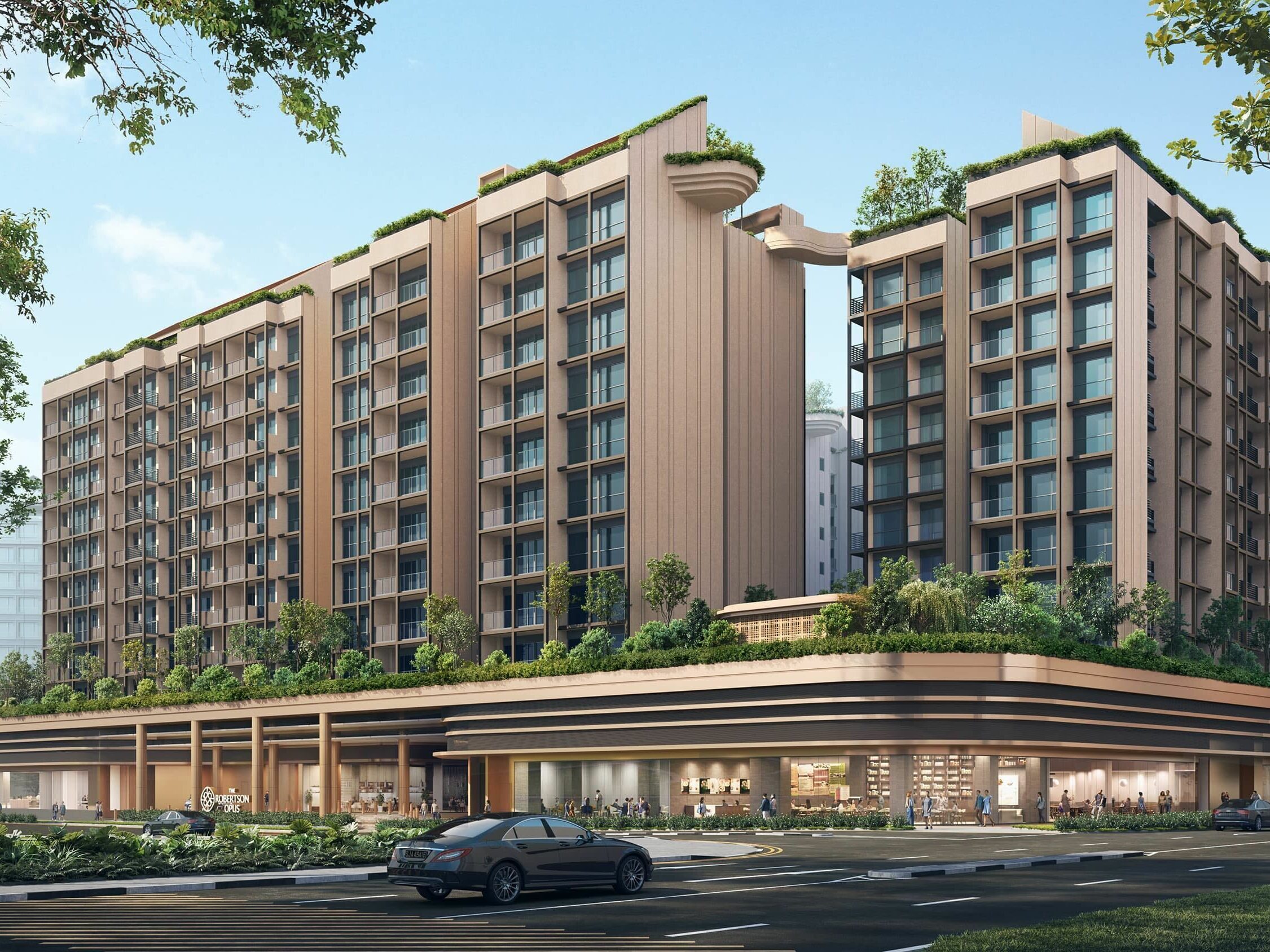
One of the most distinctive features of Robertson Opus is its 240-metre Sky Forest, a continuous rooftop terrace that links all five residential blocks. In a land-scarce CCR location, such a feature is rare.
“This isn’t just a visual element,” Klyssa noted. “It’s designed as a usable green network.” The Sky Forest functions like an elevated park, with sky lounges, yoga lawns, meditation areas and communal spaces woven throughout.
Across the entire site, more than 3,800 square metres of greenery and over 200 trees are layered from ground level upwards, creating shade, openness and a cooler living environment.
The retail podium, professionally managed by Frasers Property, will feature a curated mix of cafés and dining concepts aligned with Robertson Quay’s lifestyle positioning. While alfresco dining is no longer part of the plan, this shift reduces evening noise spillover, supporting a more comfortable residential environment above.
The Robertson Opus pricing and long-term positioning
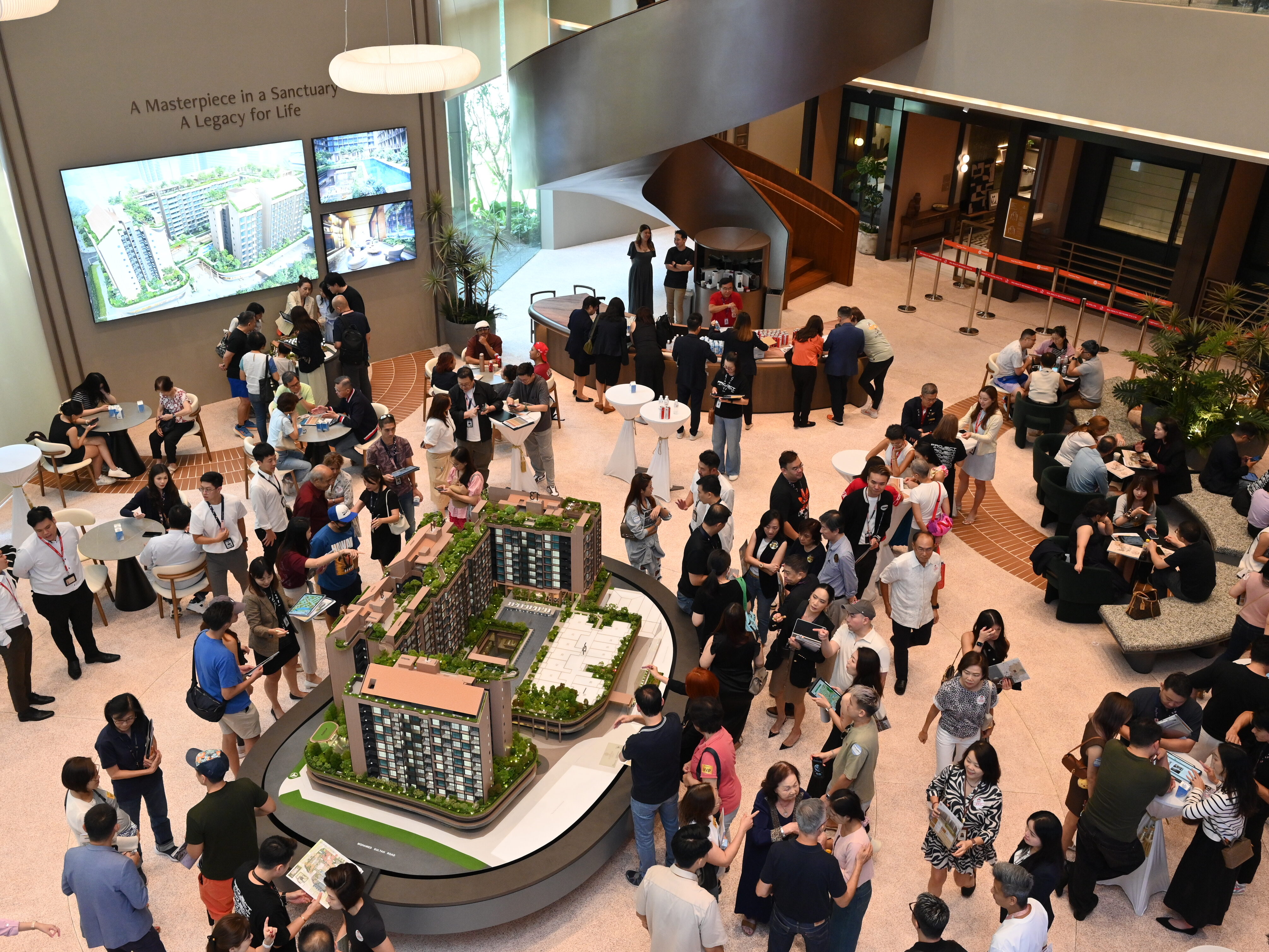
In terms of pricing, Robertson Opus is positioned in the low S$3,000-plus psf range, with entry quantums for smaller units starting from around S$1.3 million. When benchmarked against recent new launches in District 9 and the broader CCR — many of which are 99-year developments — pricing appears broadly in line rather than materially out of step.
The premium, as Klyssa pointed out, is less about headline location and more about buying into a lower-density, mid-rise development with long-term tenure, a combination that has become increasingly rare in the CCR.
Read more: [PRICE ANALYSIS] How The Robertson Opus compares with other new launches and nearby older projects
Beyond pricing, several structural factors underpin Robertson Opus’ longer-term appeal. One is the ongoing rejuvenation of the Singapore River and Clarke Quay precinct, which aligns with the URA Master Plan’s vision of transforming the area from a nightlife-led destination into a more balanced, all-day neighbourhood. Over time, this shift could support more sustainable demand and value retention.
Tenure scarcity is another critical consideration. New homes in Robertson Quay with a 999-year lease are exceptionally rare, and with most future supply expected to be leasehold, Robertson Opus could represent one of the last opportunities to secure a near-freehold home within this immediate enclave. As the project matures, this scarcity may become increasingly pronounced within the CCR landscape.
Have plans to sell your current home for a new launch condo? Book a FREE consultation with 99 advisors or let us help by connecting you with a property agent.
The post [Open House] Inside the CCR market shift and the rise of Robertson Opus appeared first on .


