

The latest episode of Open House brought together two very different, yet closely linked, conversations. First, the spotlight turned to a new prime launch in River Valley, River Modern, a 99-year leasehold project in District 9 that pairs riverfront living with direct MRT access. Then, attention shifted to the February 2026 BTO exercise, where application numbers revealed a more strategic and selective group of buyers.
Together, both discussions point to the same theme. Whether you are looking at private condos or public housing, buyers in 2026 are no longer rushing. Instead, they are weighing trade-offs carefully – between location and space, lifestyle and restrictions, immediacy and long-term value.
Table of contents
- River Modern: A rare riverfront address in District 9
- Designed for owner-occupiers, not just investors
- Pricing strategy in today’s prime landscape
- When green spaces becomes a strategic decision
- February 2026 BTO: A market that has changed character
- Micro-location now matters more than estate labels
- First-timers vs second-timers
- Size vs location: A shift in preferences
- Resale prices, SBF, and the question of urgency
- A market that is normalising, not weakening
- What to watch for the rest of 2026
River Modern: A rare riverfront address in District 9
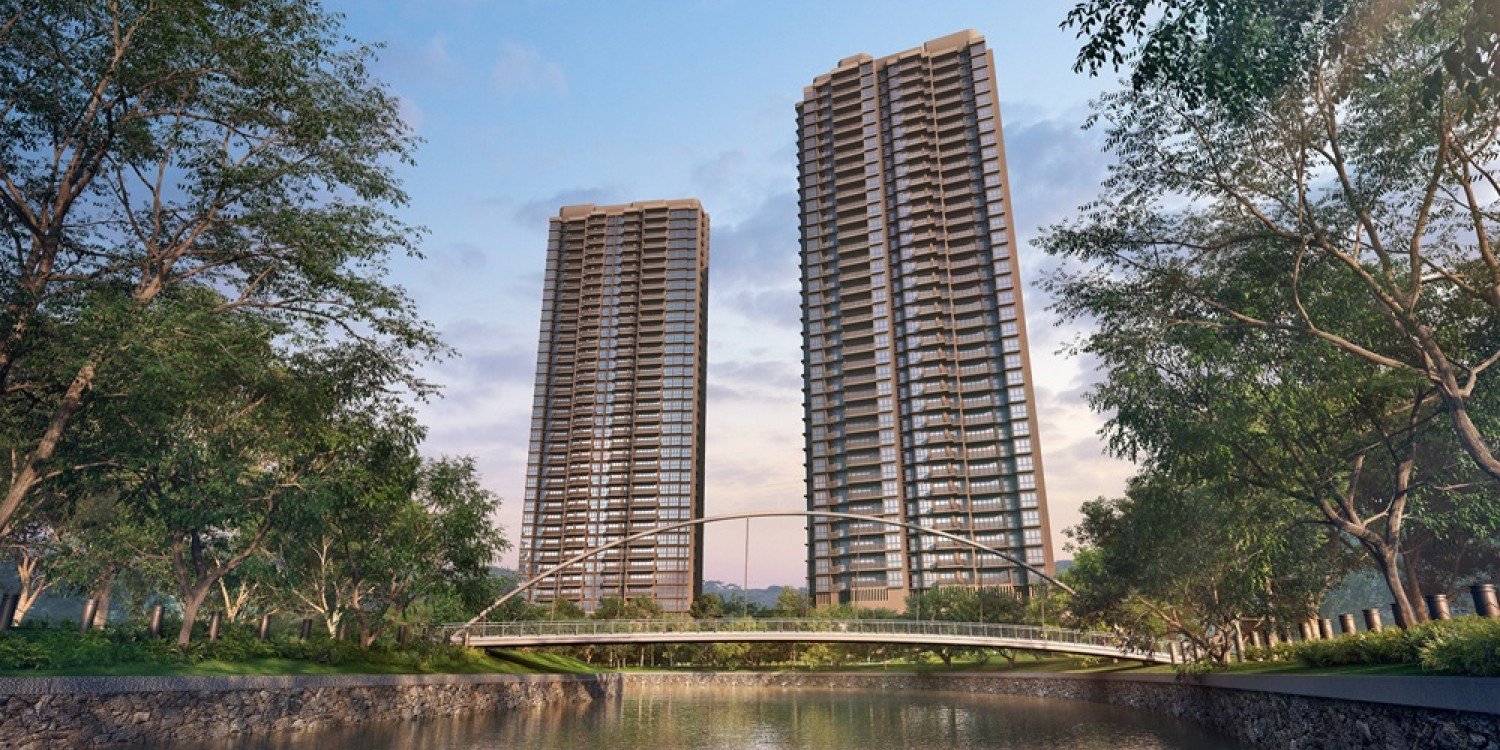
Located in River Valley, River Modern sits within prime District 9, an address long associated with prestige and centrality. The project is developed by GuocoLand and comprises 455 units on a 99-year lease. What sets it apart, however, is not just its postcode, but a combination of site attributes that are rarely found together in today’s prime market.
Speaking on the podcast, Justin Quek, Deputy Group CEO of Realion Group, repeatedly returned to one word, rare, and as he unpacked the project’s features, it became clear why that description was chosen so deliberately.
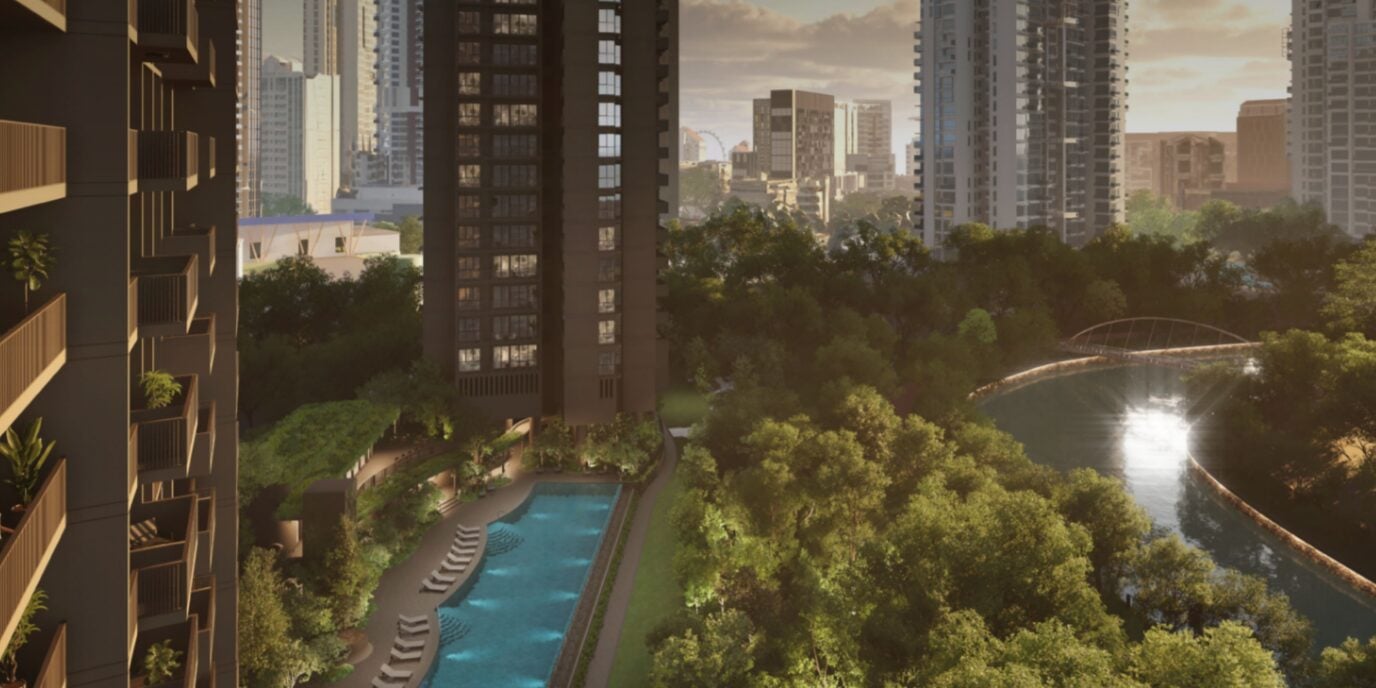
Within District 9, riverfront plots are already limited, and many developments sit along narrower stretches of water where only a small stack of units truly faces the river. River Modern, however, spans the width of the river, which allows a significant proportion of units to enjoy direct frontage. According to Justin, about 70% of the units benefit from unblocked river views, and that scale of exposure is not something commonly seen in the area.
More importantly, what distinguishes the experience here is not just the presence of the river, but the layered landscape that sits between the towers and the water. A linear park forms a green buffer before the river itself, so residents are not simply looking out at a waterway but across treetops and open greenery first, with the river unfolding beyond.
From within the apartment, the view is therefore not flat or one-dimensional. The podium has also been slightly elevated, which improves sight lines and allows many units to rise above the park canopy. As a result, the development capitalises fully on its natural surroundings while maintaining privacy and openness at the same time.
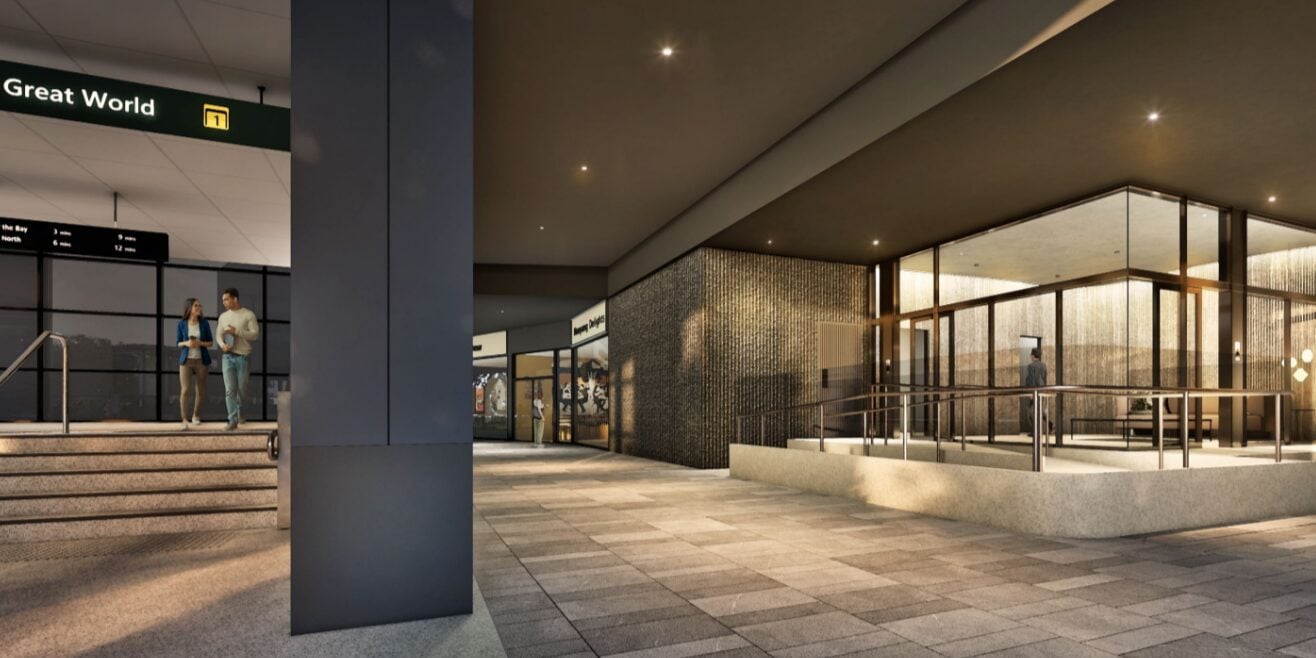
In addition to the riverfront setting, the development is directly connected to Great World MRT station on the Thomson-East Coast Line, and that underground link extends seamlessly to Great World City. Justin emphasised that this is not merely about theoretical convenience, but about daily usability, since residents can move from their home to the supermarket or the MRT train door within minutes, fully sheltered from the elements.
Taken together, these physical attributes form the foundation of the project’s long-term appeal. An MRT station is highly unlikely to be relocated, the riverfront setting will remain, and the park buffer cannot be replicated elsewhere. For buyers who take a longer view, such fundamentals tend to carry weight because they shape both lifestyle quality and future value in ways that are difficult to duplicate.
Read more here: Rare riverfront condo in District 9, River Modern starts from S$1.548 million
Designed for owner-occupiers, not just investors
Beyond its physical setting, River Modern’s positioning becomes even clearer when you examine the unit mix and layout strategy. More than 60% of the 455 units are 3- and 4-bedroom homes, and this distribution is far from accidental. Instead, it reflects a deliberate intent to attract owner-occupiers rather than a predominantly investor-led base.
As Justin explained during the discussion, GuocoLand has long held the view that developments anchored by genuine home occupiers tend to demonstrate greater resilience over time. Owner-occupiers typically hold their properties longer, are less inclined to sell immediately upon completion, and contribute to a more stable community dynamic. In turn, this stability can support capital appreciation because supply entering the resale market remains measured rather than speculative.
At the same time, a larger proportion of family-sized units naturally shapes the demographic profile of the project. Instead of a transient tenant-heavy environment often associated with smaller 1- and 2-bedroom layouts, River Modern is likely to cultivate a more settled residential base. This difference may appear subtle at launch, but over the years, it can influence everything from community cohesion to resale confidence.
For affluent buyers in the prime segment, certain features are no longer considered luxuries but expectations. The larger 4-bedroom units come with private lift access and wider frontage, both of which are now seen as baseline requirements at this level of the market. However, what stood out in Justin’s commentary was not simply the inclusion of these features, but how the layouts have been configured to maximise spatial experience.
Drawing lessons from Martin Modern, which was completed nearly a decade ago, the developer continues to apply its “inside-out” design philosophy. Rather than relying purely on headline square footage, the focus is placed on flow, proportions and how the space feels when occupied. Interestingly, when Martin Modern was first launched, some buyers questioned the appeal of a 99-year leasehold development surrounded by freehold projects. Yet over time, its profitability record demonstrated that livability and tenant demand can outweigh tenure concerns when the product is well executed.
River Modern builds on that philosophy while introducing a very different site context. Here, river frontage and MRT integration serve as the primary anchors, but the internal layouts remain equally central to the project’s identity.
Pricing strategy in today’s prime landscape
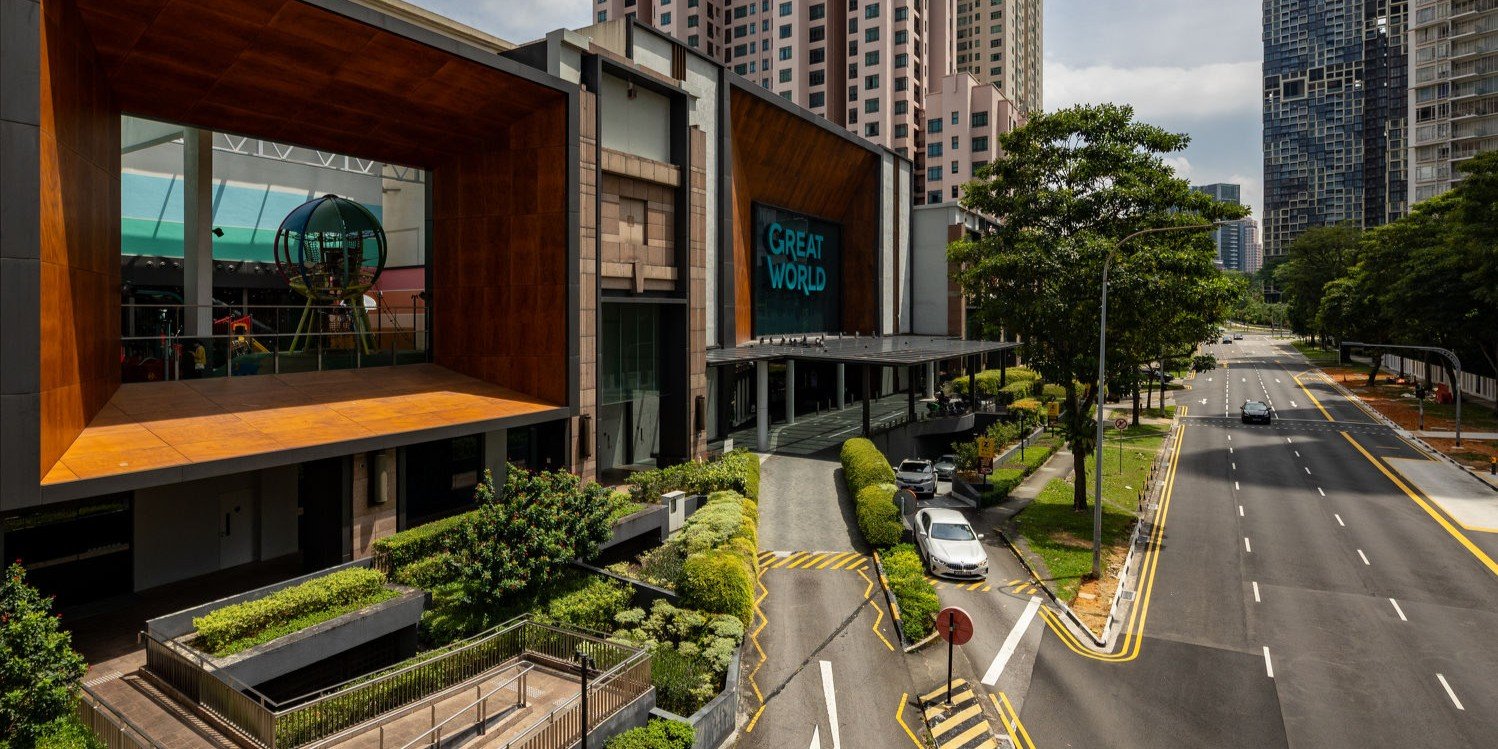
With prices starting from S$2,877 per square foot, River Modern has been positioned competitively within the prime District 9 landscape.
As of the third quarter of 2025, median new launch prices in District 9 hovered around S$3,186 per square foot. Moreover, several recent launches in the Rest of Central Region have transacted at similar or even higher levels. Against this backdrop, River Modern’s entry pricing appears measured, particularly when one factors in its riverfront orientation and direct MRT access.
Of course, price positioning is only one component of long-term value. The project also incorporates approximately 4,300 square feet of retail space within the development, and this feature introduces a less visible but potentially meaningful financial advantage. Unlike many mixed-use projects where retail ownership is separate, these commercial units fall under the residents’ MCST. Rental income generated from these spaces flows back into the development’s funds, which may strengthen sinking reserves over time. In older developments, insufficient sinking funds sometimes lead to large one-off capital calls for major repairs, so this built-in revenue stream could offer an additional layer of financial stability for residents.
When green spaces becomes a strategic decision
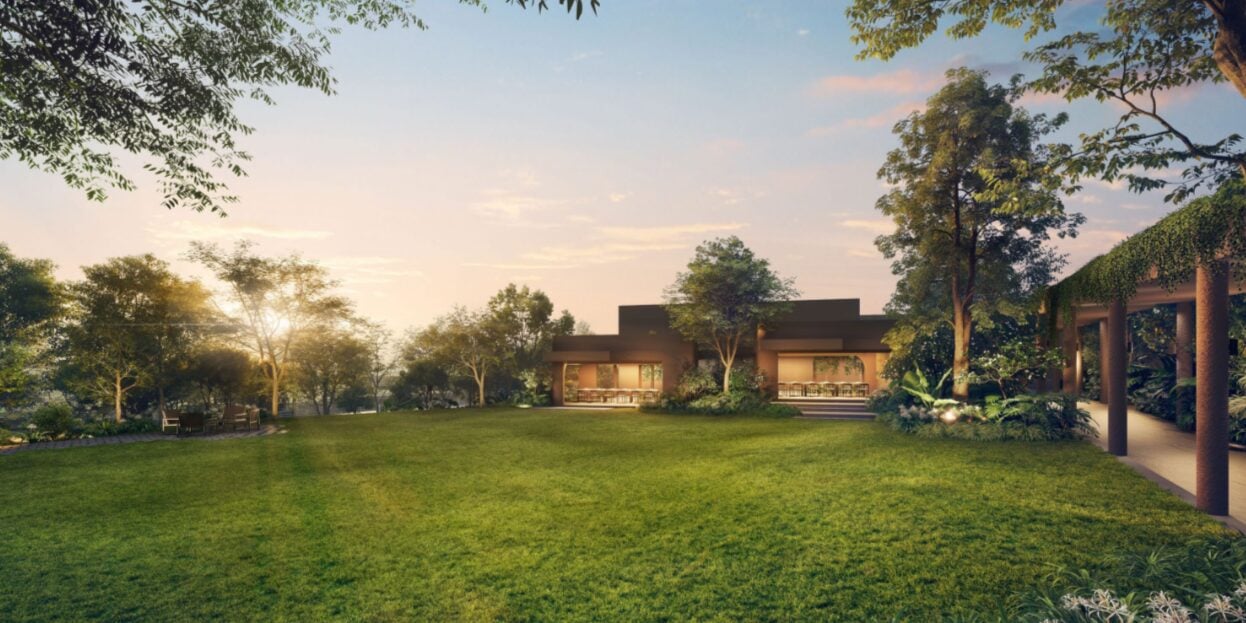
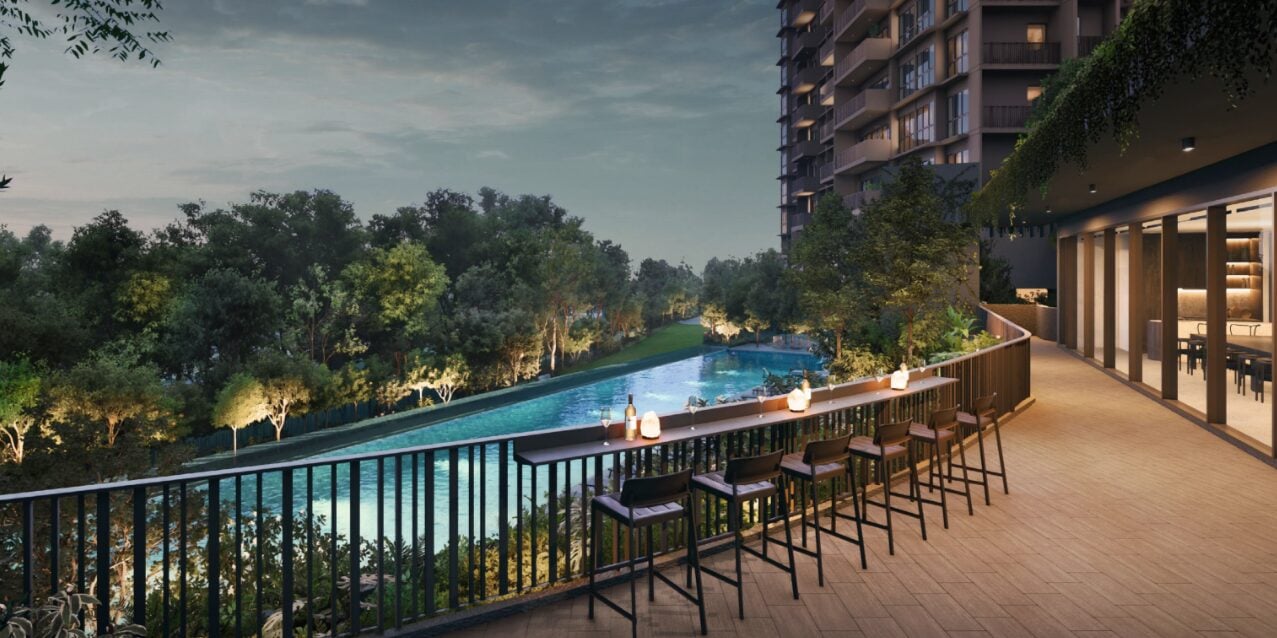
Another defining aspect of River Modern lies in how land has been allocated. More than 80% of the site is dedicated to landscaping and facilities, including a 170-metre nature trail, expansive lawn areas and a full-sized tennis court with spectator seating. In a city where land cost is significant, such an allocation reflects intentional restraint.
By limiting the building footprint and keeping the form to twin towers, the developer frees up meaningful open space within the grounds. This approach aligns with GuocoLand’s broader design language, which often emphasises large communal lawns and greenery as central lifestyle features. From a resident’s perspective, these open areas become extensions of the home, offering room for recreation, relaxation and social interaction without leaving the compound.
Over time, developments that are perceived as highly liveable often experience stronger resident retention. When a home integrates greenery, convenience and thoughtful layouts, the threshold required to convince an owner to sell typically rises. While no project is immune to market cycles, attributes that are difficult to replicate, such as riverfront positioning and extensive internal landscaping, can contribute to long-term defensibility.
Get the latest pricing and unit availability for River Modern!
February 2026 BTO: A market that has changed character
If River Modern illustrates how private developers are positioning premium projects in 2026, the February BTO exercise reveals how public housing demand is evolving under very different constraints.
Professor Lee Kuan Ok from the NUS Business School described the latest launch as one that cannot simply be labelled as “cooling.” While headline application rates may appear lower compared to peak pandemic years, the underlying dynamics tell a more nuanced story.
Instead of uniform moderation across the board, the February exercise revealed sharp contrasts. Some projects attracted overwhelming interest, while others struggled to fill quotas despite being located in historically established estates. This divergence suggests that the market has not merely cooled; rather, buyer behaviour has become more deliberate and segmented.
Micro-location now matters more than estate labels
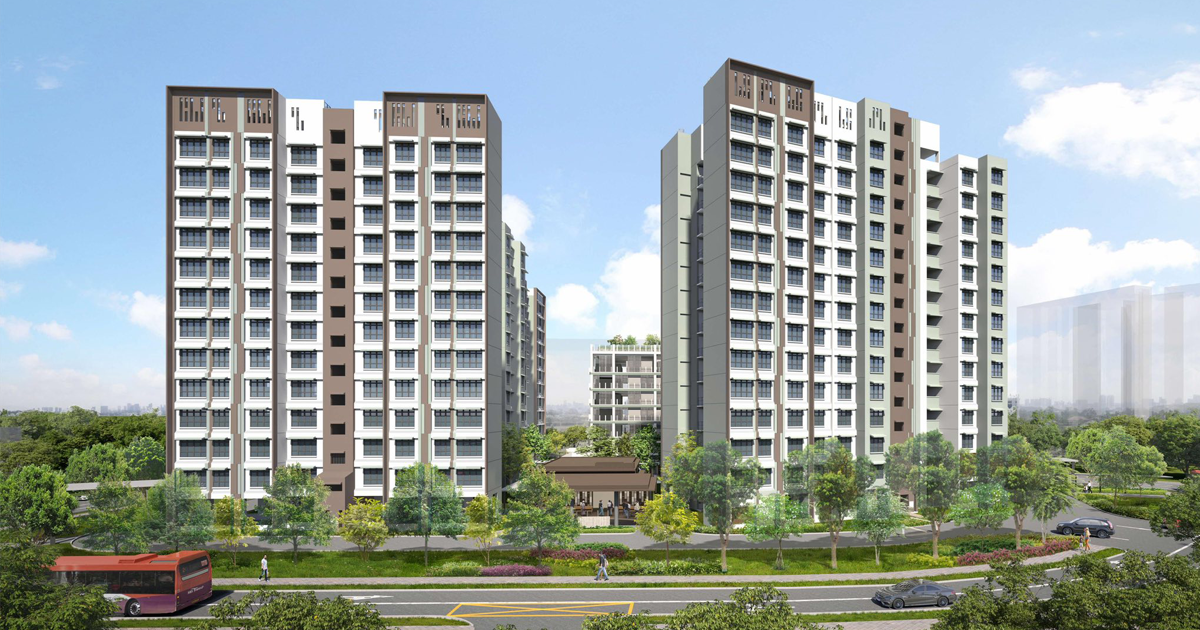
One of the clearest examples of this shift was seen in Tampines. Projects situated near Tampines MRT station and integrated amenities experienced strong demand, particularly where shorter waiting times were offered. In these cases, buyers were effectively presented with a compelling combination of connectivity, established infrastructure and quicker completion timelines.
However, the response in other mature estates was far more measured. In Toa Payoh, for example, certain Plus-classified projects saw weaker take-up, particularly where MRT access required additional commuting time. Buyers appeared increasingly unwilling to accept extended Minimum Occupation Periods (MOP) and subsidy clawbacks unless the physical location clearly justified those conditions.
Similarly, in Bukit Merah, a Prime project close to the MRT still attracted strong interest despite stricter resale rules, suggesting that when accessibility and centrality are undeniable, buyers are prepared to accept tighter restrictions.
What emerges from these patterns is that the mature versus non-mature distinction has lost predictive power. Instead, buyers are assessing micro-location, walkability to MRT stations, proximity to daily amenities, and the stage of estate development with far greater scrutiny.
Rather listen to this podcast? Head over here: Open House: A radio show/collabo between CNA 938 and 99.co
First-timers vs second-timers
The February data also highlighted a striking divergence between first-timer and second-timer applicants. The median first-timer application rate stood at 0.8, indicating relatively manageable competition in many projects. In contrast, second-timers faced a median rate of 13.3, reflecting significantly tighter quotas.
Part of this gap stems from structural allocation rules, as over 90% of Plus and Prime flats are reserved for first-timers. Yet beyond quotas, the psychological profiles differ sharply. First-time applicants are often younger couples with tighter financial constraints and evolving household plans. For them, a 10-year MOP carries real weight because life circumstances may shift within that timeframe.
Second-timers, on the other hand, typically enter with equity from their existing flat and a clearer sense of long-term housing preferences. Their decision-making is often more location-driven and less sensitive to resale restrictions, particularly if they intend to remain in the flat for an extended period.
The same BTO project, therefore, can appear either flexible or restrictive depending on the applicant’s stage of life.
Size vs location: A shift in preferences
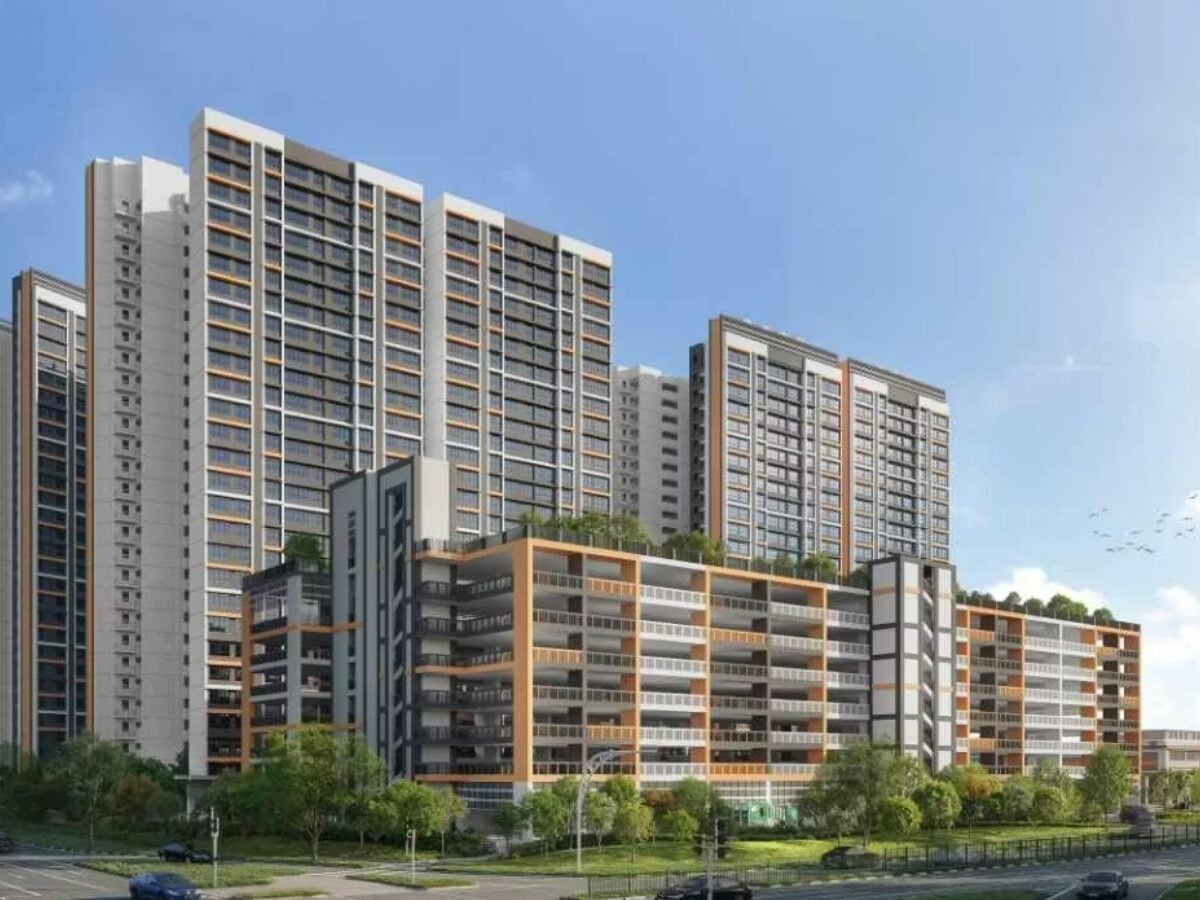
Perhaps the most telling signal this round was the under-subscription of 5-room flats in Sembawang, which historically would have drawn strong interest. This outcome suggests that the long-standing assumption that larger flats are universally preferred may no longer hold.
Household sizes are gradually shrinking, and lifestyle patterns have evolved. Many families increasingly rely on neighbourhood amenities, hawker centres, childcare facilities, MRT access and retail clusters, as extensions of their living environment. In such cases, a slightly smaller flat in a well-connected estate may feel more functional than a larger unit in a less developed area.
This does not mean space has lost value. Rather, it indicates that buyers are now more willing to trade square footage for accessibility when budget constraints require prioritisation.
Resale prices, SBF, and the question of urgency
Resale flat prices, while moderating in growth, remain elevated in absolute terms, with 2025 recording a high number of million-dollar transactions. Against that benchmark, even Prime BTO flats with longer occupation restrictions continue to represent substantial implicit subsidies compared to equivalent resale units nearby.
Interestingly, the Sale of Balance Flats (SBF) exercise outperformed BTO in application intensity this round. As the only SBF exercise scheduled for 2026, urgency was concentrated, particularly since some units were near completion and offered significantly shorter waiting times.
For households facing lease expiries, impending marriages or prolonged unsuccessful applications, SBF functions almost as subsidised housing delivered at resale speed. The consistent demand for these units suggests that urgency-driven segments remain structurally present in the market, even as overall BTO rates normalise.
A market that is normalising, not weakening
Application rates have eased gradually over three consecutive launches, declining from 4.2 to 3.6 and now to 3.3. However, Professor Lee characterised this trajectory as normalisation rather than deterioration.
Supply has increased meaningfully in recent years, and panic-driven behaviour has receded. Buyers appear to be studying launch schedules strategically, timing their applications and evaluating trade-offs with greater precision. At a national level, supply targets have been exceeded, yet imbalances remain localised, particularly in MRT-adjacent, fully developed estates where demand continues to outpace availability.
What to watch for the rest of 2026
Looking ahead, several indicators will merit close attention. Future Prime launches in genuinely rare locations will test buyers’ tolerance for restrictions. The relative strength of SBF compared to BTO will reveal whether urgency remains concentrated. Additionally, if projects consistently underperform where classification labels appear misaligned with accessibility, policymakers may need to refine how categories are communicated.
Across both the private and public segments, the underlying message remains consistent. Buyers in 2026 are not retreating from the market; instead, they are approaching it with sharper analysis, clearer priorities and a willingness to make deliberate trade-offs.
The post [Open House] Prime living by the river, and what February’s BTO tells us about 2026 appeared first on .
