

Thomson Reserve reportedly drew over 23,000 visitors in its first week of preview, the highest turnout for a new launch project in 2026. This highly anticipated launch in District 20 brings together sought-after characteristics in Singapore’s urban landscape: direct MRT access, proximity to nature as well as established schools, and the convenience of a mature neighbourhood.
Sales bookings for Thomson Reserve are set to commence on 31 October 2026.
Developed by UOL, Singapore Land and CapitaLand Development (CLD), Thomson Reserve has attracted attention from both prospective homeowners and investors. The limited new supply within the district is one of the major factors behind this.
Its closest benchmark, JadeScape, launched in 2018 and has since recorded substantial price growth, offering a useful reference point for prospective buyers assessing the potential of another large-scale development in the area.
Table of contents
-
A rare opportunity to enter a mega development in District 20
-
What is a reasonable entry price for Thomson Reserve?
-
JadeScape offers a useful benchmark for long-term price growth
-
Why a larger resale market could support long-term liquidity
-
MRT access could be Thomson Reserve’s strongest advantage
A rare opportunity to enter a mega development in District 20
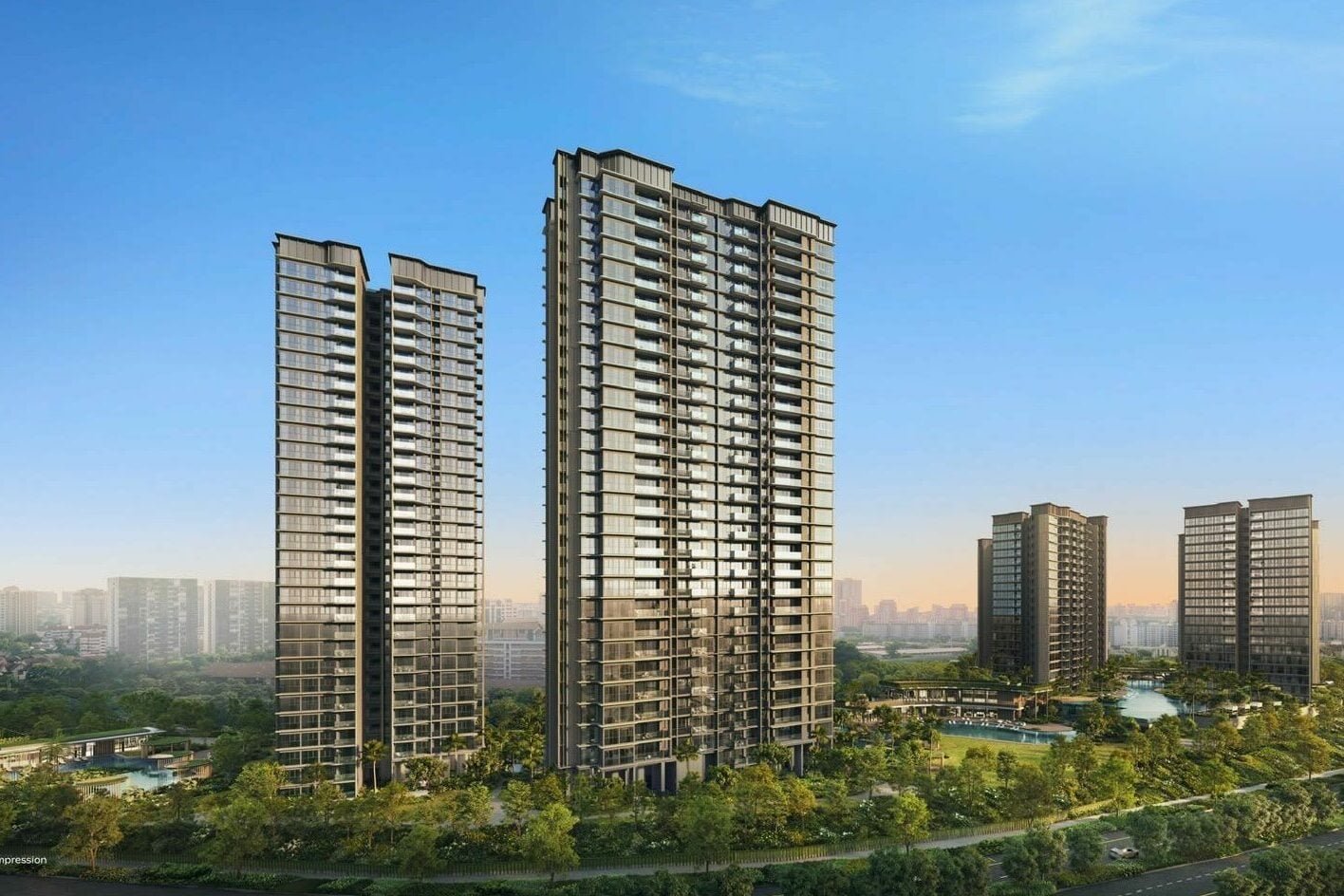
Thomson Reserve will comprise 1,268 residential units across six towers on an approximately 51,567 sqm site along Bright Hill Drive. The development will have four 21-storey blocks and two 30-storey blocks, with 2- to 5-bedroom units across its Classic and Luxury collections.
Its scale alone is notable in a market where condominiums with more than 1,000 units remain relatively uncommon. More importantly, it will be only the second mega condominium in District 20 after the 1,206-unit JadeScape, which entered the market almost a decade ago.
This limited supply could work in Thomson Reserve’s favour over the longer term. An established residential district already has amenities and transport infrastructure in place, while a lack of new launches can leave buyers with fewer newly built alternatives nearby.
However, scarcity alone does not guarantee capital appreciation. A development can still underperform if its launch prices are too high or demand fails to keep pace with supply. For prospective buyers and investors alike, the key consideration is whether Thomson Reserve’s entry price adequately reflects its location and other advantages.
What is a reasonable entry price for Thomson Reserve?
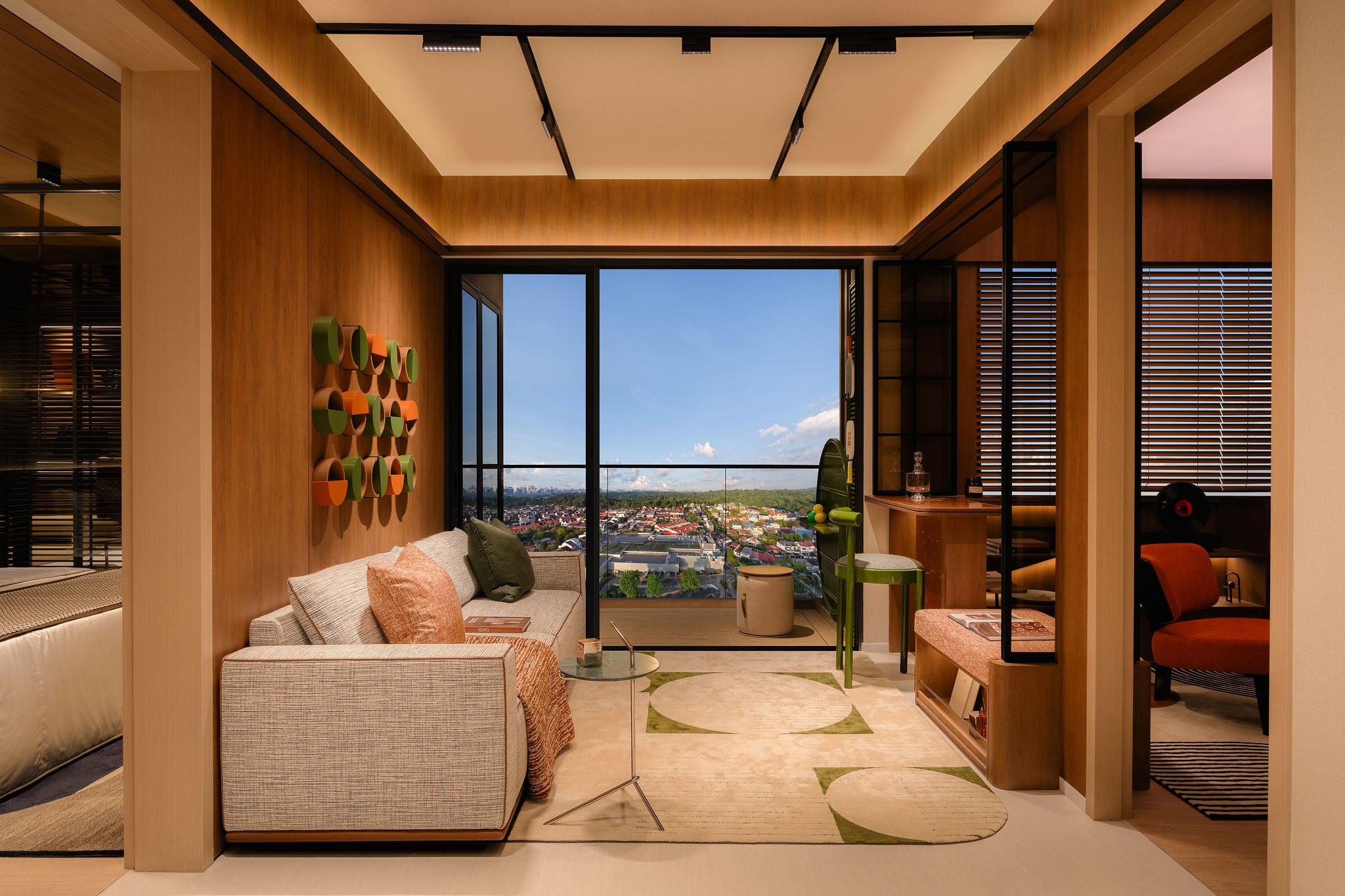
Thomson Reserve’s starting prices provide a useful first indication of its investment proposition.
| Unit Type | Starting Price | Size | Starting PSF |
|---|---|---|---|
| 2-bedroom | S$1.544 million | 592 sqft | S$2,608 |
| 3-bedroom | S$2.503 million | 947 sqft | S$2,643 |
| 4-bedroom | S$3.388 million | 1,238 sqft | S$2,737 |
Receive the latest pricing and unit availability for Thomson Reserve!
Looking at its previous District 20 benchmark, Thomson Reserve’s starting prices may appear to carry a premium over JadeScape’s current average resale price of around S$2,325 psf.
However, comparing development-wide averages can be misleading. JadeScape’s 3-bedroom units, for instance, have averaged around S$2,600 psf, bringing the gap closer to Thomson Reserve’s entry prices for its 3-bedders.
It is also worth noting that Thomson Reserve will launch with a fresh 99-year lease and adopts the harmonised gross floor area (GFA) framework, unlike JadeScape. These differences should be considered when comparing their prices, alongside unit sizes, layouts and other attributes.
Comparisons with similar new launches across Singapore
Beyond immediate location, Chuan Park Residences offers another useful reference point. Like Thomson Reserve, it is a large development in the RCR that emerged from a collective sale. Launched in November 2024 at an average of S$2,586 psf, Chuan Park’s average price had risen to around S$2,640 psf by October 2026.
The figures represent growth of less than 2% from launch. This relatively stable pricing over the last two years suggests that the project entered the market close to prevailing buyer expectations, rather than needing a significant price correction after launch.
However, Chuan Park is also a pre-GFA-harmonisation project. Adjusting its current average price upwards by around 7% to account for the harmonised GFA framework would put it at approximately S$2,825 psf on a comparable basis.
Against this benchmark, even Thomson Reserve’s 4-bedroom units, which have the highest starting price among the three unit types listed, begin below Chuan Park’s adjusted average. This suggests that Thomson Reserve’s entry pricing is not necessarily out of step with the market.
Vela Bay provides a further reference point. Launched in April 2026, the development’s average price had approached S$2,900 psf by October. Vela Bay is located within the OCR, whereas Thomson Reserve is in the RCR, which generally occupies a more central market position.
If Thomson Reserve units can be secured at around S$2,800 to S$2,900 psf, their pricing would broadly align with these recent market benchmarks. Even better, units secured closer to Thomson Reserve’s starting prices of around S$2,600 psf could offer a greater buffer against potential price corrections in the future.
JadeScape offers a useful benchmark for long-term price growth
While launch pricing helps establish whether Thomson Reserve offers reasonable entry value, the existing JadeScape provides a longer-term reference point for assessing how a large condominium in District 20 might perform.
Both developments occupy a similar position in District 20’s private residential market. They are large projects in an established residential area, with quick access to the wider Thomson and Marymount transport network.

When JadeScape launched in 2018, units were sold at an average price of around S$1,670 psf. By 2026, its average resale price had reached approximately S$2,330 psf, based on 52 transactions recorded so far this year. This represents an increase of roughly 40% from its launch average.
The project has also recorded individual resale transactions with profits exceeding S$1 million, including cases involving holding periods of around five years.
However, prospective buyers should not assume that Thomson Reserve will follow the same trajectory. Differences in entry price, unit configuration, floor level, facing and purchase timing can all affect returns.
For those evaluating Thomson Reserve, JadeScape is best treated as a benchmark rather than a forecast. The more important exercise is to assess how much of the potential growth has already been priced into Thomson Reserve at launch.
If its initial pricing leaves room for appreciation relative to comparable developments, investors may have a stronger basis for considering the project.
Why a larger resale market could support long-term liquidity
A mega development’s investment appeal is not limited to potential price appreciation. Its size may also support a more active resale market, which can be useful when owners eventually want to sell.
With 1,268 units, Thomson Reserve will have a larger pool of potential sellers and buyers than a boutique condominium with only a few hundred homes. Over time, this could generate more comparable transactions and provide a clearer picture of prevailing market prices.
Looking at a few examples in the OCR, where many of Singapore’s largest condominium developments are located, we can see how this plays out in practice.
Treasure at Tampines versus The Jovell
Treasure at Tampines, Singapore’s largest condominium development, has 2,203 units and reached TOP in 2023. The Jovell, a smaller development with 428 units, reached TOP in 2022. Both are in Tampines and were launched around a similar period.
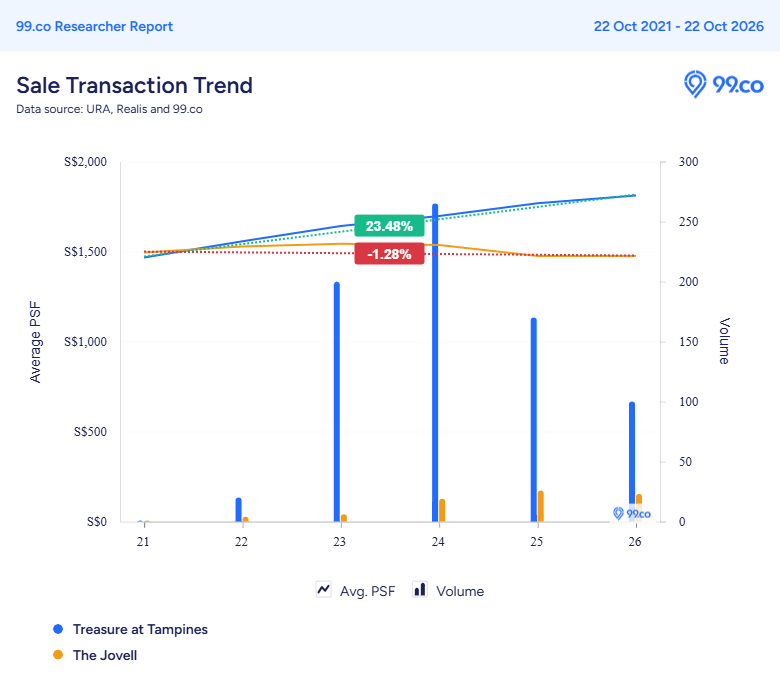
Over the 5-year period examined, resale prices at Treasure at Tampines increased by around 23%, while prices at The Jovell declined by approximately 1%. The difference is notable, particularly given their broadly comparable starting points in 2021 at around S$1,500 psf.
Treasure at Tampines, now averages above S$1,800 psf, benefits from a much larger residential community and a greater pool of units that can generate resale transactions. For Thomson Reserve, the key point is that a large unit count may help sustain market visibility and transaction activity.
The Florence Residences versus Sengkang Grand Residences
Both located in District 19, the comparison between The Florence Residences and Sengkang Grand Residences offers a more closely matched example of this dynamic.
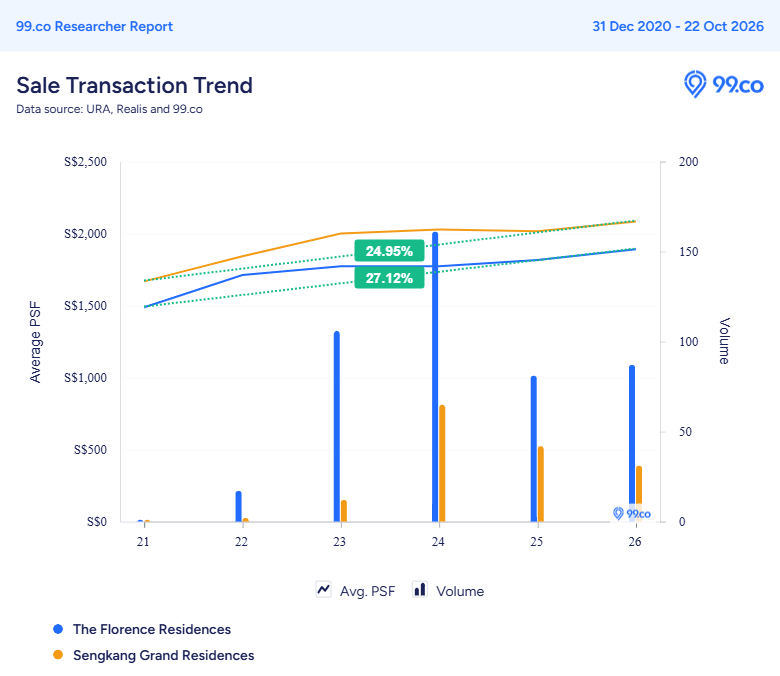
The Florence Residences has 1,410 units, while Sengkang Grand Residences has 680 units. Both reached TOP in 2024. Over the 5-year period examined, resale prices at The Florence Residences rose by around 27%, compared with approximately 25% at Sengkang Grand Residences.
The Florence Residences has edged ahead in price growth, even though Sengkang Grand Residences has a stronger immediate MRT connection, with Buangkok station about a 5-minute walk away. The Florence Residences, meanwhile, is around a kilometre from Hougang MRT station.
That said, a larger unit count does not automatically guarantee faster sales or stronger pricing. Resale liquidity still depends on market conditions, competing listings, individual unit attributes and sellers’ price expectations.
Find Out Your Home’s Worth with
X-Value®
— Singapore’s Trusted Property Valuation
MRT access could be Thomson Reserve’s strongest advantage
Thomson Reserve’s scale becomes more compelling when paired with its transport connectivity.
Upper Thomson MRT station on the Thomson-East Coast Line (TEL) is less than a 2-minute walk from the development. This gives residents direct access to a rail network serving several established residential and commercial areas, with connections to other MRT lines through interchange stations.
Convenient rail access can broaden a property’s appeal to both owner-occupiers and tenants. Residents may place a premium on shorter commuting times, while tenants can compare the convenience of living near an MRT station with the rents charged by less accessible alternatives.
For investors, this creates a potential source of underlying demand beyond the development’s facilities and unit count.
Transport connectivity can also help a development remain relevant as surrounding neighbourhoods evolve. As more of the TEL network becomes operational, residents can access a wider range of destinations without relying entirely on buses or private transport.

JadeScape provides another useful local comparison. Located around a 5-minute walk from Marymount MRT station, the development has recorded approximately 25% resale price growth over the past five years, compared with around 18% across similar-aged RCR developments over the same period.
Stirling Residences offers a further reference point. The 1,259-unit development is around a 7-minute walk from Queenstown MRT station and has recorded approximately 21% resale price growth over five years, outperforming the wider RCR market over the same period.
Both developments combine substantial scale with convenient MRT access, similar to what Thomson Reserve has to offer. Their historical performance supports the case for examining these attributes together when evaluating a long-term property investment.
However, past performance is no guarantee of future returns. Whether Thomson Reserve proves to be a sound investment will depend on the price paid, the unit selected and how demand evolves over time. Ultimately, Thomson Reserve is worth a closer look, whether you are considering it as a pure investment or a place to call home.
Stay updated with the latest news and insights on Singapore’s new launch market here.
The post Evaluating Thomson Reserve from a long-term investment point of view appeared first on .
